A lot has been going on here at the A3 farm, with the obvious exception of keeping the blog entries up to date.
My bride and I both took last week off from our non-farm jobs and mostly spent the time on farm related tasks (big surprise).
We did a few things to get ready from the opening of the farmers market on November third.
We are selling eggs at the market. We plan to use my brides lap top computer to show photos and maybe videos of our production system.
I made a video that proves 1) Steven Spielberg is safe in his job, and 2) I’m a sucker for corny old Bob Wills tunes, even those done by Asleep at the Wheel.
It is in Windows Media Format.
Link to video
We also spent two days at the fall meeting of the Florida Meat Sheep Alliance, held this time at Lake City Community College. I’ll do a separate post about this. I got some good pictures.
Monday, October 23, 2006


Thursday, October 05, 2006
Bovine boogie
 I don’t own a bull. I own two cows and a calf.
My next-door neighbor keeps 10 cows and a bull. His bull is a nice one that he named turbo. Every bit of two thousand pounds of vary large farm animal.
We often help each other out, I check his stock when he leaves town for example.
Last year he let me run my cows in with his to get them bred. We did this at midsummer when he had more grass than he could use.
This year rain has been scarce, except when I am trying to make hay of course. His pasture is not holding up too well.
My ground is still under stocked and I have some grass to spare. So this year we are running our cattle together on some of my ground. We turned them all in on Monday.
Just now I came by and saw my two cows and his bull lounging under the big shade tree.
Is it just my optimistic nature, or do they look like they have all just finished having a cigarette?
Home made peeps
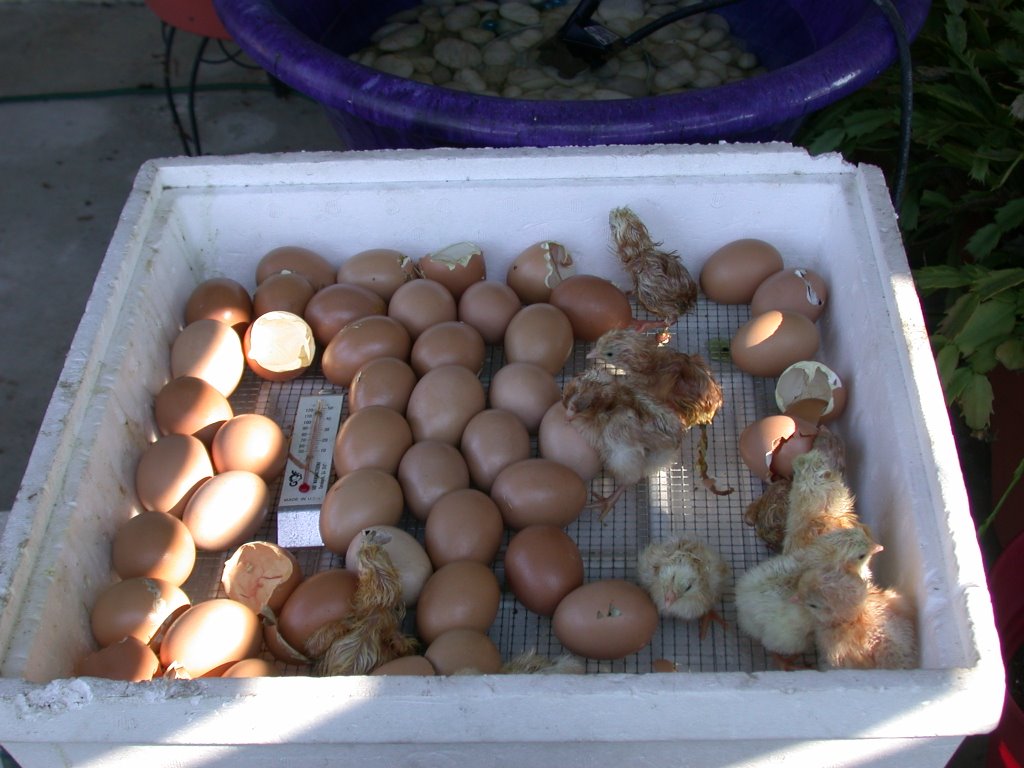 A while ago I figured out that in order to sell eggs at the new farmers market I would need to offer them as fertilized hatching eggs rather than table eggs.
This is, for the most part, a dodge to avoid AG department busybodies who seem to believe that eggs come from factories and therefore prohibit anyone who doesn’t have a factory from selling eggs. They don’t know about chickens apparently.
Well, I may be forced to play wink and nod, but I wanted to know if such a claim would be true. So I borrowed a small incubator from a friend and installed four-dozen eggs in it.
I keep two roosters with my laying hens, so the eggs should indeed be fertile. Up to now I have never hatched any.
Well, I more or less forgot about them. Every few days I’d roll them around in the incubator. I lost track of when I put them in there.
Yesterday they started to hatch. I knew they were supposed to hatch of course, but I was still surprised.
 I was at the feed store yesterday buying feed for the laying hens. It never entered my mind to get chick starter.
I went out just now and got starter feed, then put the ones that have hatched into the brooder.
Ten have hatched so far.
Wednesday, October 04, 2006
Aerial Photography courtesy of google earth
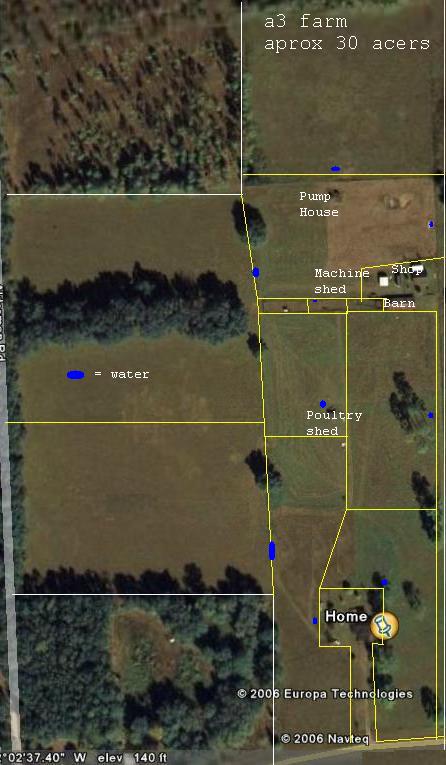 If you have never played with google earth then you still have a good bit to learn about wasting time.
Having said that, if you are lucky enough to live in a place where the satellites take a close look it is possible to get some good aerial photos of home (or just about anywhere else).
I pulled this photo of our farm and did an edit of it. Cool, huh?
I added indications of where the rotational grazing paddocks are, where water is available, and where the various buildings are.
The upper and lower left is adjoining land that we don’t use. The center left is land that belongs to my neighbor that we graze. It is subdivided into two paddocks at the moment. The large rectangle at the right is our land.
Monday, October 02, 2006
A busy weekend for farm work.
 We moved the laying hens first thing Saturday morning.
Chickens in thier new location
Then we went off to Lake City to buy a new breeding ram.
Our friends Lewis and Janice had several rams they were willing to sell.
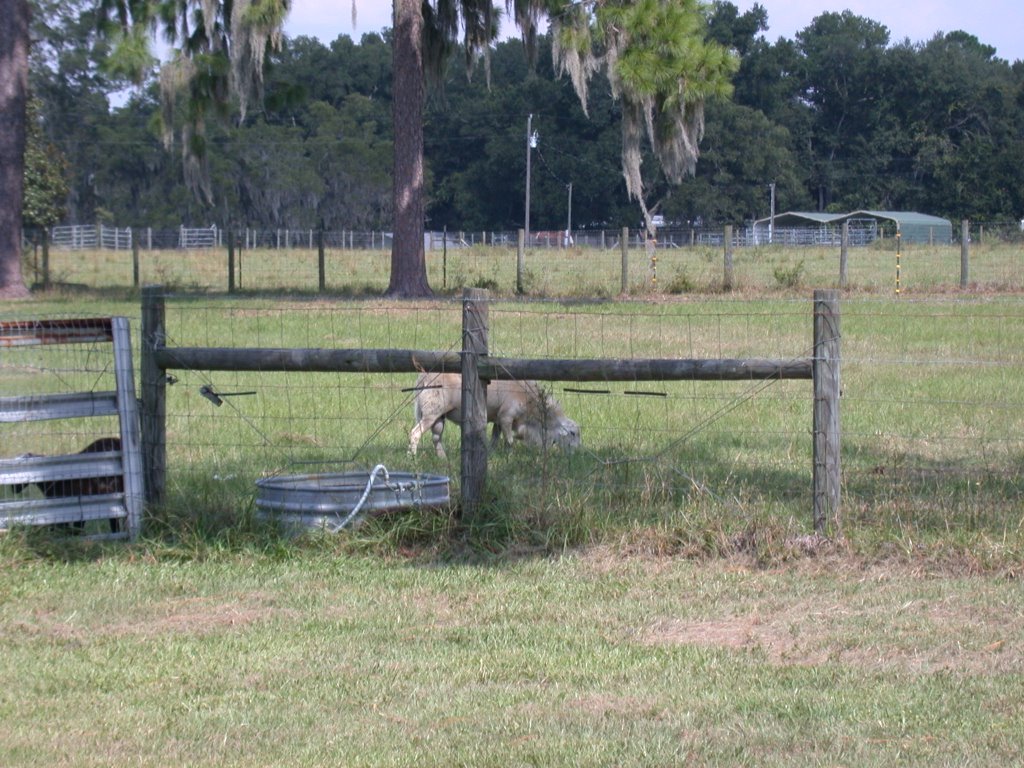 We picked out a nice Katahdin ram about a year and a half old.
The new Katahdin ram (click on photo to enlarge)
Katahdin is a hair sheep breed (no wool therefore no shearing required) that does fairly well in our climate.
Sunday we did a bunch of fencing work replacing some two-strand electric twine paddock fences with three-strand 14-gage aluminum wire.
These fences needed to be upgraded because some of the twine was failing from UV exposure, and because we now know that this is where we want the fence to be for quite a while into the future.
 We were not sure where the best place was when we put in the twine fencing. Twine can be moved, wire cannot.
Some of the new three strand fence
In the evening we penned up the cattle in the barn. The Vet is coming today to vaccinate the calf and to de-horn its mama. The mama is a fairly tame beast, but I don’t need to get gored even by accident.
Monday, September 25, 2006
More hay
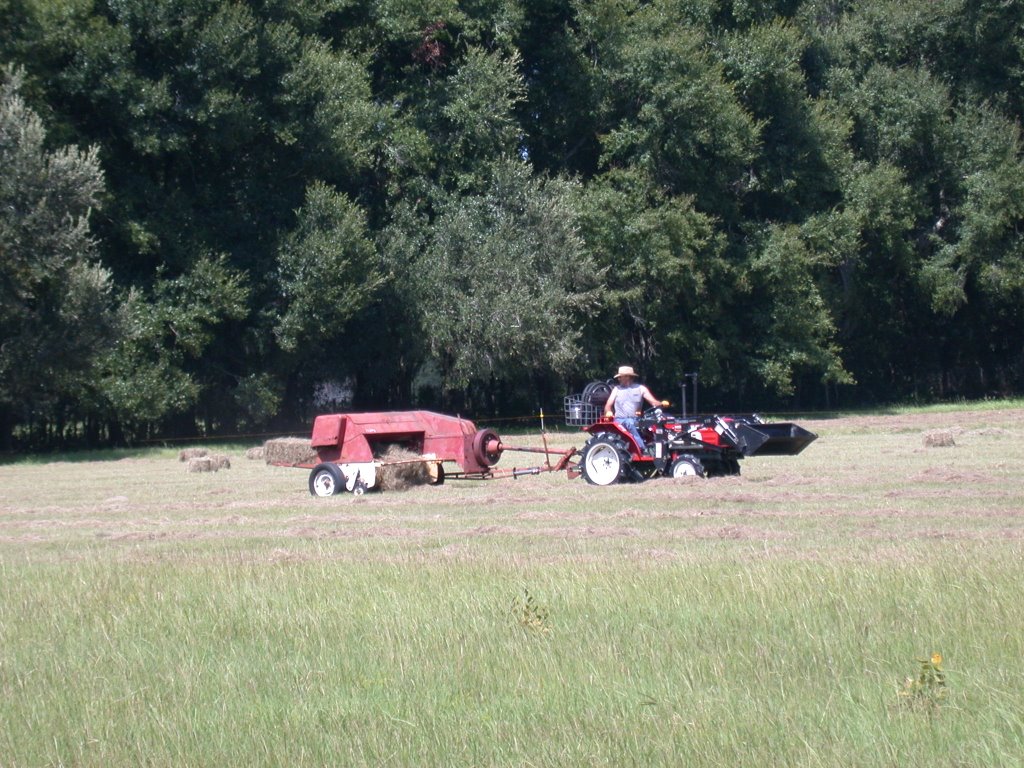 I cut about five more acres of hay Wednesday and Thursday evenings, raked it Friday, and baled it up on Saturday.
The baler had a problem with the knotter, but only after the job was almost finished.
I just stopped at that point and arranged to get it fixed.
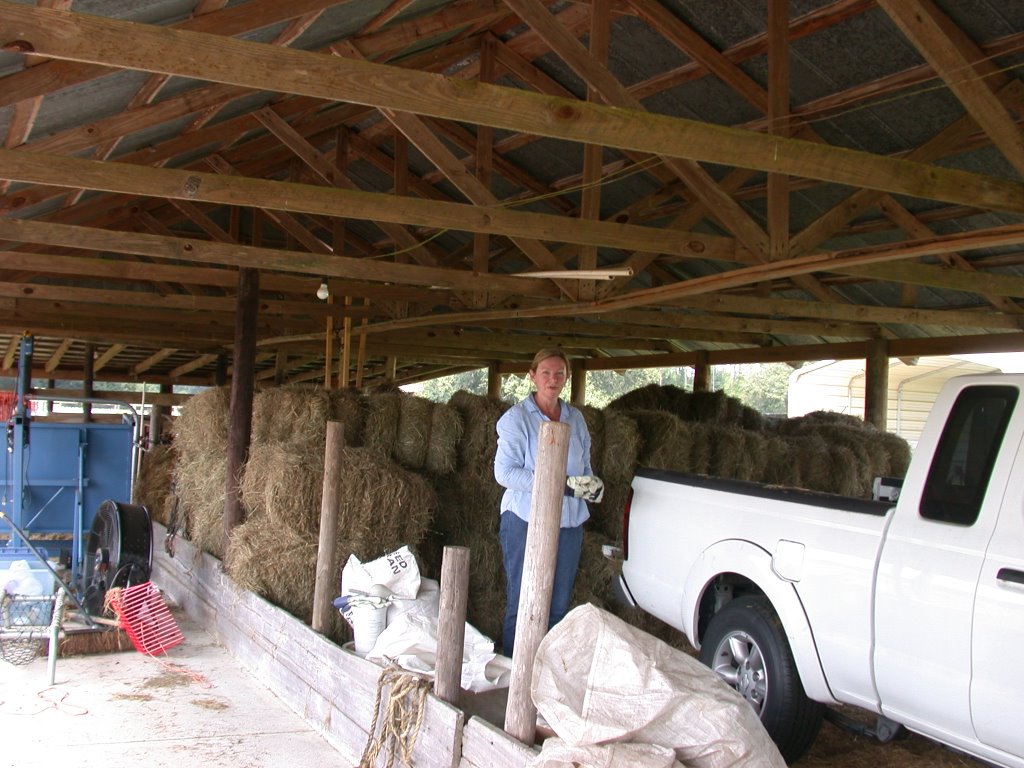 By 8:30 or so Saturday it was all in the barn.
My bride is a very accomplished hay stacker.
I just drive the truck and make helpful suggestions.
Thursday, September 21, 2006
Funky old cedar tree
 I was cutting hay last evening and admiring the weird old tree in the back paddock.
Monday, September 18, 2006
Make hay while the sun shines
 Well, at least while the rain holds off.
The forecast at midweek last week was for rain Wednesday followed by clear dry weather until at least today.
It did indeed rain Wednesday, but from then it was cloudy most of the day and even a bit threatening in the late afternoons. But here’s the thing, no actual rain.
 This set up a rare occurrence here on the A3 farm, hay that gets from the field to the barn without getting rained on at all.
I cut two paddocks, one Thursday evening and one Friday evening.
I raked them both up on Saturday. One was bailed Saturday the other Sunday.
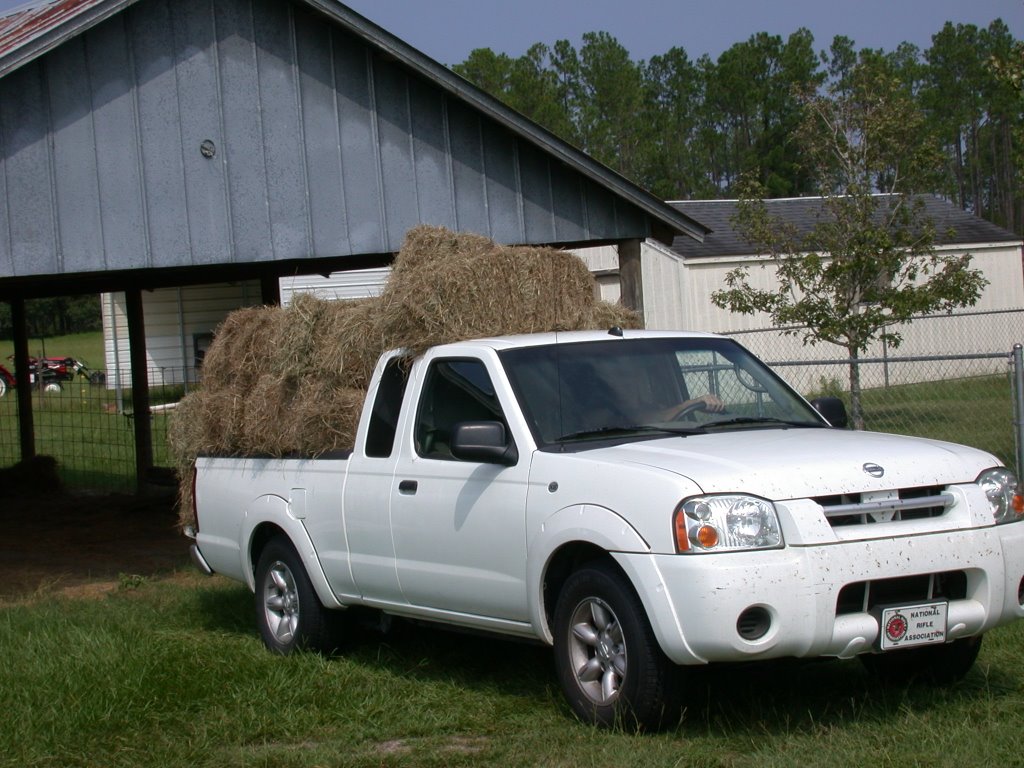 We loaded it all in the barn Sunday, the first batch early, the second batch in the late evening.
It is a bit easier to work outside now that the high temperatures for the day is just in the high eighties.
That’s about ten degrees cooler than it has been. Morning and evenings are really quite pleasant.
Tuesday, September 05, 2006
Selling eggs
I’ve written here about the fact that a new farmers market is being established near here and my interest in selling eggs there.
Here are some interesting developments on that front.
As is often the case in the Byzantine realm of public regulation selling eggs is both allowed and forbidden.
First the forbidden part, sent to the market manager as the result of official inquiry:
What I get from this is that no one has told that Ag Dept folks about chickens. They think eggs come from factories and if you don’t have a factory you can’t sell eggs.
Next comes the allowed part:
Sell the eggs as fertile hatching eggs. Meaning that they are intended to be used to hatch new chicks and are therefore not food. The “guidelines” above then do not apply.
Then of course if someone buys such an egg and then in total disregard for all public health guidelines, actually eats it, the vendor is not involved.
I’m not sure which side of the looking glass this is, but it is your tax dollars at work.
Here are some interesting developments on that front.
As is often the case in the Byzantine realm of public regulation selling eggs is both allowed and forbidden.
First the forbidden part, sent to the market manager as the result of official inquiry:
Guidelines for Selling Eggs
1) Facility must have an annual food permit.
2) Facility must have an approved water and sewage system that meets requirement for a food processor. A residential system is not acceptable.
3) Facility must be separate from living quarters.
4) Facility must have hot and cold water of sufficient quantity to meet processing requirements.
5) Processor must use a USDA approved shell egg sanitizer and have the appropriate test kit.
6) Facility must be equipped with equipment to properly wash and air dry the eggs. The temperature of the wash water must always be 10 degrees F or greater than the temperature of the eggs. The temperature of the wash water must be a minimum of 90 degrees F. The temperature of the approved sanitizer must be at least 10 degrees F greater than the wash water temperature. Appropriate records must be maintained for this procedure.
7) Facility must meet all requirements of the Food Code.
8) Facility must have a three compartment sink to wash, rinse, and sanitize equipment.
9) Eggs cannot be sold in cartons. They can only be sold in bulk or in flats.
10) Facility must have cooling capability to store the eggs at 41 degrees F or less.
11) A placard must be displayed at the point of sale stating the following: “These eggs have not been graded as to quality and weight”. The placard must be not smaller than 7 inches by 7 inches in size.
12) The unclassified eggs (washed eggs which have not been graded for size and quality) may have no more checks, dirties, leakers, or loss than those allowed for Florida Grade B eggs.
13) Nest eggs (eggs that have not been washed, sized, or graded for quality) may not be sold to retail outlets, consumers, or public eating places.
February
1, 2006
What I get from this is that no one has told that Ag Dept folks about chickens. They think eggs come from factories and if you don’t have a factory you can’t sell eggs.
Next comes the allowed part:
Sell the eggs as fertile hatching eggs. Meaning that they are intended to be used to hatch new chicks and are therefore not food. The “guidelines” above then do not apply.
Then of course if someone buys such an egg and then in total disregard for all public health guidelines, actually eats it, the vendor is not involved.
I’m not sure which side of the looking glass this is, but it is your tax dollars at work.
OK so what about that hay
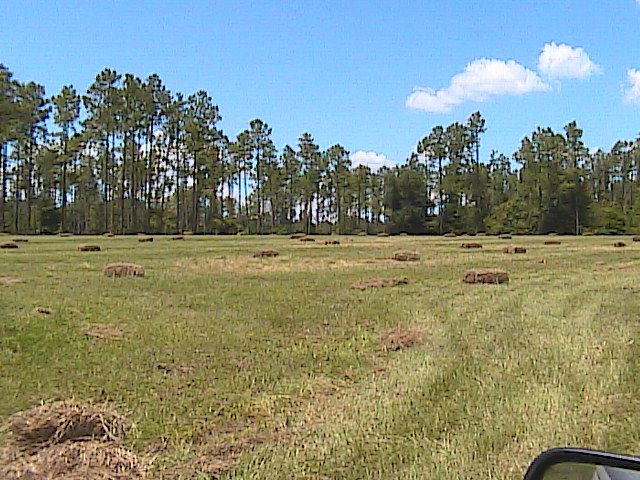 So this is how things turned out with the continuing saga of the back hay field.
 I got most of it baled up, all but what would have been 15 or 20 bales + or -.
Out of that most was not feed quality, so I have maybe 50 bales of feed hay and 125 or 150 bales of mulch.
I would have preferred to use it all as feed but I have use for mulch.
On top of that is the fact that this pasture has been under grazed for the past few years, and when it was cut the grass was just left to decompose in the field. The result was a lot of thatch over the turf.
A lot of that thatch wound up in this hay. Getting it up off the field will do very good things for the pasture allowing the rain to soak in better and the soil to breath a bit, all good.
What I intend to do with all that mulch is to spread it in a thick layer over and area I intend to plant in corn and cowpeas next spring. I let it sit that way all winter, probably run chickens over the area. That should kill the grass and retain moisture in the soil so I can plant it no till in the spring, no need to plow or any of that. That’s my theory anyway; we’ll see how it goes.
Monday, August 28, 2006
Dank
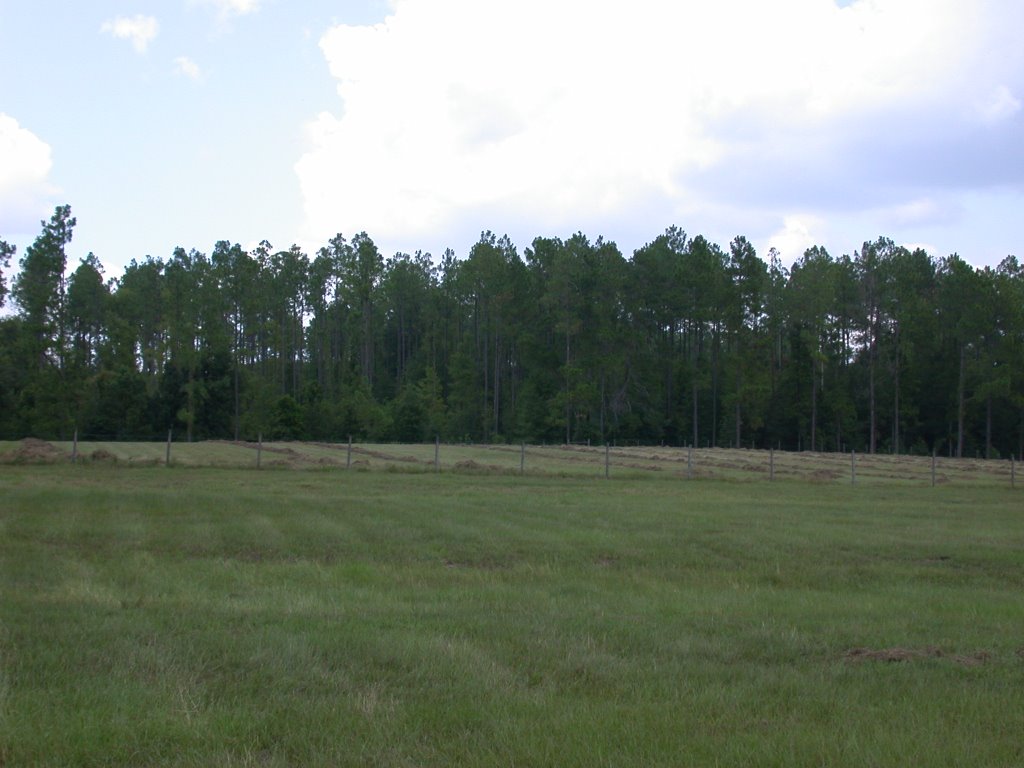 It seems like I spent the whole weekend removing and attaching implements on the back of the tractor.
I took the mower off, put the rake on, took the rake off, and attached the baler. You get the idea.
I finished cutting the hay Friday evening. Then of course it rained shortly after I finished. When hay is freshly cut rain doesn’t damage it nearly as much as if it happens after it is dry.
I raked it up it up Saturday morning then waited for it to finish drying out. I’m still waiting.
It has not rained on the hayfield since Friday evening late. I’m not sure the grass can tell, it is as humid as the bottom of a lake. It’s just not drying out.
If I’m going to get it baled and off the field while it still makes good feed I’ll need better luck than I’ve had so far. I may have a large load of mulch on my hands.
Thursday, August 24, 2006
More hay to make
The weather forecast is for hot and humid conditions with 30 to 40 percent chance of afternoon or evening thunderstorms.
This was for forecast in June and will be the forecast until October. Unless there is a hurricane bearing down on us, that is Florida in the summer time.
I check the forecast frequently before I try to go out and do farm work. I have no idea why.
Tuesday evening shortly after five o’clock I came out of the bathroom and saw through the south window, out of the corner of my eye, without really paying attention, some calves my neighbor keeps in the pasture across the road from my house running more or less in my direction.
I intended to go out and start to cut hay in the back pasture.
I had spent all afternoon in my office with a good view to the north. The sky was partly cloudy. That means I could look at big black clouds or clear blue sky, my choice and no need to move my head much.
I went to the front door, put on my hat, opened the door and noticed the lambs in our front pasture running towards me. They were trying, without success, to outrun the rain formed into a squall line moving up the driveway. The calves across the road were already soaked and had given up the race.
It rained for less than an hour. The rain gauge in the front flower bed recorded just over and inch.
 Wednesday just past noon another brief shower gave us a soaking. By about six o’clock I was out cutting hay. The tractor doesn’t kick up much dust under these conditions you see.
With our sandy soil and temperatures in the nineties, things get tolerably dry quickly.
Anyway, so much for the drought.
I got the field a bit less than half cut.
This was for forecast in June and will be the forecast until October. Unless there is a hurricane bearing down on us, that is Florida in the summer time.
I check the forecast frequently before I try to go out and do farm work. I have no idea why.
Tuesday evening shortly after five o’clock I came out of the bathroom and saw through the south window, out of the corner of my eye, without really paying attention, some calves my neighbor keeps in the pasture across the road from my house running more or less in my direction.
I intended to go out and start to cut hay in the back pasture.
I had spent all afternoon in my office with a good view to the north. The sky was partly cloudy. That means I could look at big black clouds or clear blue sky, my choice and no need to move my head much.
I went to the front door, put on my hat, opened the door and noticed the lambs in our front pasture running towards me. They were trying, without success, to outrun the rain formed into a squall line moving up the driveway. The calves across the road were already soaked and had given up the race.
It rained for less than an hour. The rain gauge in the front flower bed recorded just over and inch.
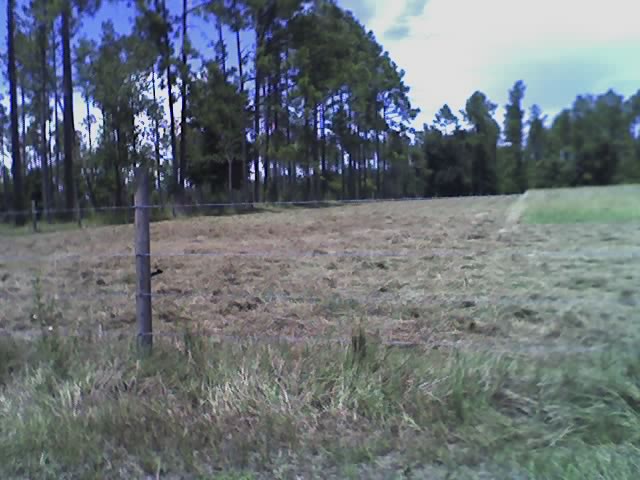 Wednesday just past noon another brief shower gave us a soaking. By about six o’clock I was out cutting hay. The tractor doesn’t kick up much dust under these conditions you see.
With our sandy soil and temperatures in the nineties, things get tolerably dry quickly.
Anyway, so much for the drought.
I got the field a bit less than half cut.
Tuesday, August 22, 2006
Hay in the barn
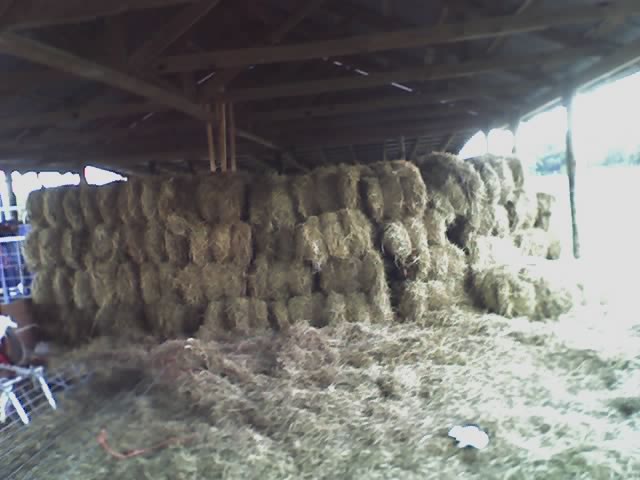 The over the hill gang showed up as promised Monday to do all the adjustments on the hay baler.
 They got here a little before noon and left about three o’clock.
When they left, not only were the adjustments made, all the hay in the field was baled and stacked in the barn. All this while I was stuck in my office with a phone in my ear.
Who says you can’t get good help these days!
It was a fairly small load of hay, less than 50 bales, but it looked better than I thought it would after being rained on.
I went right back out last evening and mounted the mower back on the tractor and sharpened the blades.
I intend to start cutting the larger field all the way at the back of our land this evening.
Saturday, August 19, 2006
Making Rain
I’m going to rent myself out as a rainmaker.
If I go to some desert area, all that needs to happen to turn it into a beach is for me to cut hay.
It’s been so dry here for most of the summer that the sand fleas are farting dust, and now this.
Friday evening about dusk one of those little thunderstorms that is about 100 yards wide dumped about an inch of rain on my hayfield.
I turned the windrows over Saturday morning, but there is so much humidity in the air nothing is drying out. There was another quick shower in the afternoon but I don’t think it made any difference.
It will be Monday before it’s ready to bale.
 All suited up with no way to make hay.
Monday, when I go back to being a computer geek instead of a farmer.
Oh well, the joys of farming part time are many.
My crew, the world famous over the hill gang, a.k.a. Misters Cooney and Nelson are going to make enough hay to insure the equipment is all adjusted up and working properly. This is because they worked on the knotter and bale chamber over the winter.
If I go to some desert area, all that needs to happen to turn it into a beach is for me to cut hay.
It’s been so dry here for most of the summer that the sand fleas are farting dust, and now this.
Friday evening about dusk one of those little thunderstorms that is about 100 yards wide dumped about an inch of rain on my hayfield.
I turned the windrows over Saturday morning, but there is so much humidity in the air nothing is drying out. There was another quick shower in the afternoon but I don’t think it made any difference.
It will be Monday before it’s ready to bale.
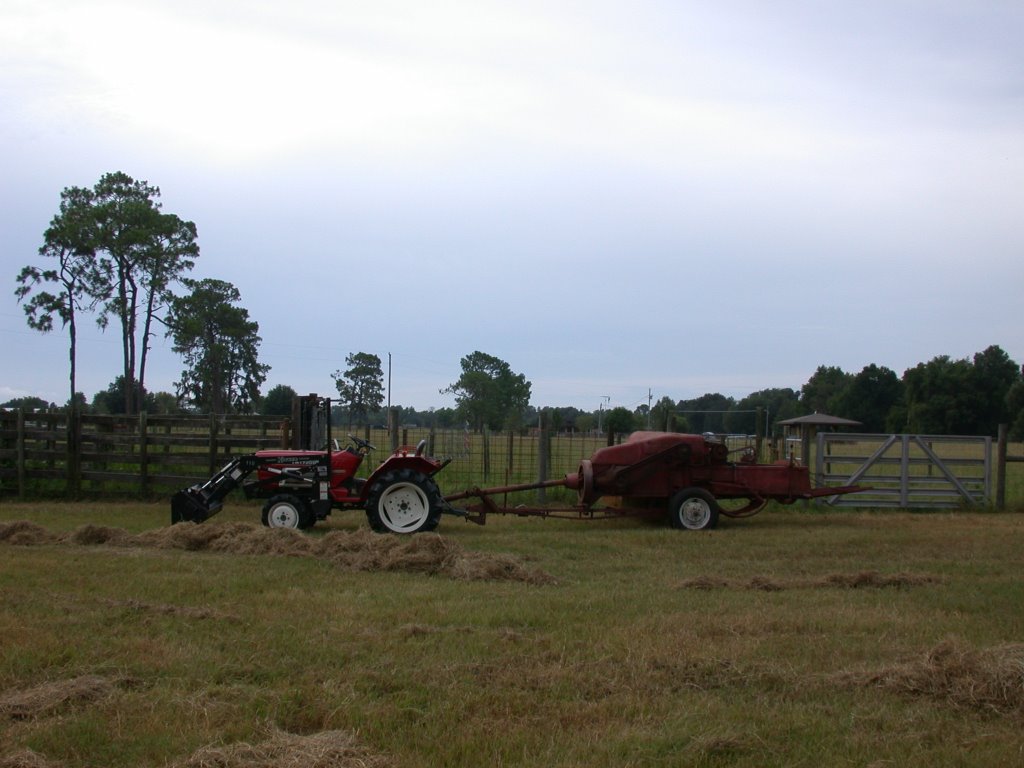 All suited up with no way to make hay.
Monday, when I go back to being a computer geek instead of a farmer.
Oh well, the joys of farming part time are many.
My crew, the world famous over the hill gang, a.k.a. Misters Cooney and Nelson are going to make enough hay to insure the equipment is all adjusted up and working properly. This is because they worked on the knotter and bale chamber over the winter.
Friday, August 18, 2006
Making Hay
 Last year I had trouble putting up hay, getting enough time without rain for the hay to cure was almost impossible. The best hay I put up had been rained on once.
So far this year it looks like that wont be a problem. It has been so dry that in some places it is barley necessary to cut it to get it to dry out. It is almost straw in the field.
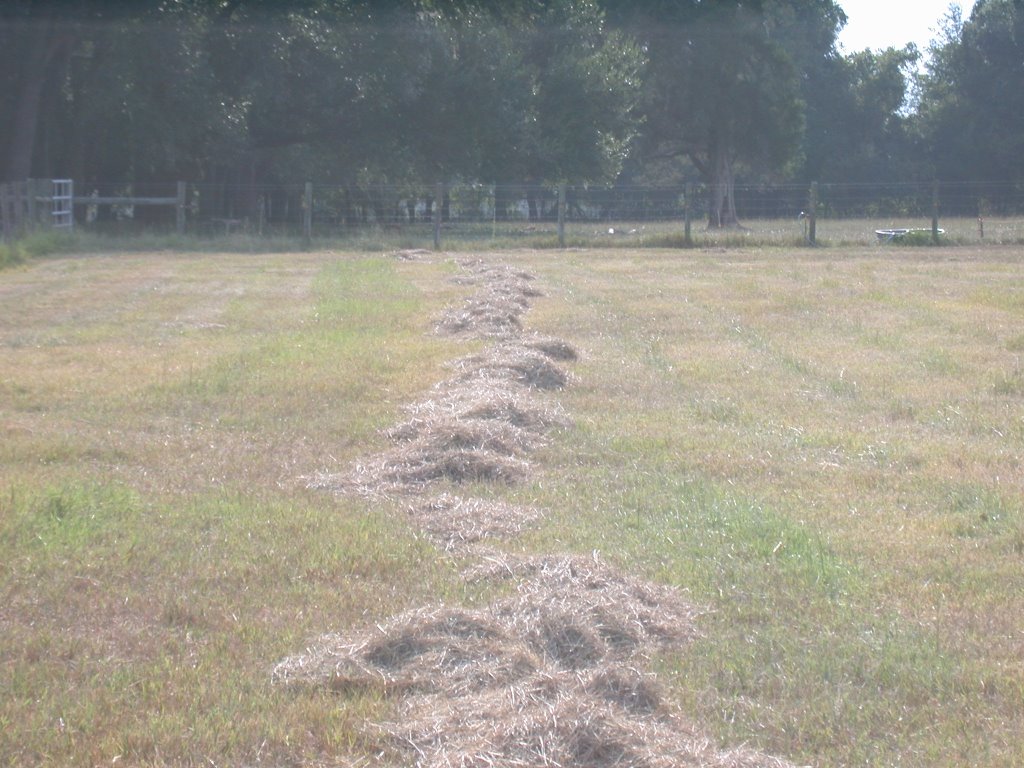 I’m starting with the center field on our land. I cut it Tuesday evening, raked it last night. The plan is to bale it up Saturday.
This is just a small field, about three acres. It is also the only field I baled last year.
It produced about 250 bales then, it will not produce nearly as much this year.
The plan is to bale up another field next week that is just less that twice this big next week. That is if everything goes well with this first field.
Monday, August 14, 2006
About time!
Regular readers of this blog (Hi Mom!) probably think I’ve died or broke my typing finger or something.
I’m here and all my digits are in working order.
What we (the whole local part of the family and myself) have done however is something that keepers of livestock almost never get to do, that is to leave the farm for several days at a time.
We all went out to Colorado for a family event that was a combination family reunion and celebration of the 50th wedding anniversary for my aunt and uncle.
Our friend and sometimes co-conspirator Mr. Cooney came by and took care of the daily chores and checked on all the critters.
That made it possible. We are grateful and very lucky to have such friends.
Recent farm news:
Friends with a straight run batch of Buff-Orrington chickens brought the cockerels over to be converted from obnoxious little ankle peckers into tasty little fryers.
The job was done with very little trouble in just a couple of hours thanks to the whiz bang plucking machine.
----
We had a bad episode where the some of the sheep developed internal parasites that had become resistant to the Ivomec drench we have been using.
We wormed them at the same time we weaned the lambs. I miss diagnosed the problem as weaning stress, the result being three dead sheep.
I did eventually figure out what was going on and re-treated all those that needed it with a different drug.
They all seem to have responded well to that treatment.
----
This week’s goal is to get the hay crop underway. I plan to cut evenings this week, rake on Friday evening and bale over the weekend.
We have been struggling with very little rain lately, almost but not quite a full-blown drought.
I have noticed that one thing that is more effective than a rain dance or even scheduling a parade is for me to cut hay.
That has been known to cause flash floods. It would almost be worth it.
I’m here and all my digits are in working order.
What we (the whole local part of the family and myself) have done however is something that keepers of livestock almost never get to do, that is to leave the farm for several days at a time.
We all went out to Colorado for a family event that was a combination family reunion and celebration of the 50th wedding anniversary for my aunt and uncle.
Our friend and sometimes co-conspirator Mr. Cooney came by and took care of the daily chores and checked on all the critters.
That made it possible. We are grateful and very lucky to have such friends.
Recent farm news:
Friends with a straight run batch of Buff-Orrington chickens brought the cockerels over to be converted from obnoxious little ankle peckers into tasty little fryers.
The job was done with very little trouble in just a couple of hours thanks to the whiz bang plucking machine.
----
We had a bad episode where the some of the sheep developed internal parasites that had become resistant to the Ivomec drench we have been using.
We wormed them at the same time we weaned the lambs. I miss diagnosed the problem as weaning stress, the result being three dead sheep.
I did eventually figure out what was going on and re-treated all those that needed it with a different drug.
They all seem to have responded well to that treatment.
----
This week’s goal is to get the hay crop underway. I plan to cut evenings this week, rake on Friday evening and bale over the weekend.
We have been struggling with very little rain lately, almost but not quite a full-blown drought.
I have noticed that one thing that is more effective than a rain dance or even scheduling a parade is for me to cut hay.
That has been known to cause flash floods. It would almost be worth it.
Monday, July 24, 2006
Chicken Labels
Sunday afternoon it rained.
I was pretty much worn out from all that working in the heat so I took that for an excuse to flop down in my easy chair and look at the TV.
You have to understand that while I do look at the tube from time to time, it has been many years since I was able to sit through most of the nonsense it shows. I just look at documentaries and ball games, and those filtered through the TiVo.
I wound up looking at a couple of farm shows from RFDTV. They were conventional Agribusiness shows put on by different State Farm Bureau organizations.
This all got me thinking about chickens.
According to Farm Bureau the current price for eggs is thirty some cents per dozen. Broilers are going for a similar price per pound. Really.
That’s the whole story from the Commodity Ag report. What is not part of that number I feel sure is the fact that I get 2.50 a pound for broilers and the same price for a dozen eggs.
I recently read a blurb on the Internet posted by my State Extension Service that stated flatly that there were no independent egg producers in my State. None, really.
The poultry industry, be it eggs or broilers, is one of the worlds most tightly integrated markets. It all goes thorough two or three huge companies. Farmers contract with them to raise poultry under tightly controlled circumstances in monstrous numbers.
There are more people raising small numbers of chickens in farmyards and suburban backyards by far than there are factory style poultry farmers. Of course the factory farmers raise such large numbers of birds that they account for the overwhelming majority of the poultry out there.
It seems likely to me that even the Extension Service people are aware that some people have backyard flocks. If pressed they would probably admit that it is possible that some of the eggs and meat from these flocks is bought and sold.
This activity doesn’t get included in the numbers because somehow it doesn’t count. It is not agribusiness. I’m not arguing that it should count; I’m not arguing at all, I’m just making observations.
I was at a grocery store near here a while ago. I noticed that they had more than the standard eggs on offer. They had brown eggs, cage free eggs, organic eggs, and a few other variations.
Someone has figured out that some people will pay a premium price for eggs that are special. Clearly the shopper is being invited to believe that these eggs are produced in a way that is closer to a backyard flock than a food factory.
In the last decade or so many laws have been passed controlling the clams made on those fancy egg carton labels.
This was not done for the benefit of those keepers of backyard flocks.
It was done to help the big integrators pretend they are keepers of backyard flocks, or near enough as to make no difference.
This, it seems to me, is the whole point of the “organic food” industry.
Back in the day if someone told you that something was organic, it was a simple if somewhat imprecise way of saying that it was produced using old fashioned, artisan techniques, and was not immersed in petrochemicals or hosed down with any sort of nuclear waste.
Now if you see a food label that claims the contents are organic, what is required for that product to qualify for that label is precisely defined by statute, but probably does not mean what the casual customer thinks it means.
It is a sham intended to make the customer think he or she is getting something they are not.
To get through all the red tape required to qualify for organic labeling requires resources that are not available to small-scale producers, absolutely including the willingness to wade through all that bureaucracy.
If you imagine organic food, I bet the image you conjure up is of items that do not even have labels.
For someone who cares where his or her food comes from, the only sure way to know is to raise it your self or get it directly from the producer. This would have to be a producer who has shown you the details of production, or at least earned your trust.
Agribusiness can’t do this. What they can do is come up with whatever sort of marketing drive that folks seem to like.
That’s what organic labeling is.
I was pretty much worn out from all that working in the heat so I took that for an excuse to flop down in my easy chair and look at the TV.
You have to understand that while I do look at the tube from time to time, it has been many years since I was able to sit through most of the nonsense it shows. I just look at documentaries and ball games, and those filtered through the TiVo.
I wound up looking at a couple of farm shows from RFDTV. They were conventional Agribusiness shows put on by different State Farm Bureau organizations.
This all got me thinking about chickens.
According to Farm Bureau the current price for eggs is thirty some cents per dozen. Broilers are going for a similar price per pound. Really.
That’s the whole story from the Commodity Ag report. What is not part of that number I feel sure is the fact that I get 2.50 a pound for broilers and the same price for a dozen eggs.
I recently read a blurb on the Internet posted by my State Extension Service that stated flatly that there were no independent egg producers in my State. None, really.
The poultry industry, be it eggs or broilers, is one of the worlds most tightly integrated markets. It all goes thorough two or three huge companies. Farmers contract with them to raise poultry under tightly controlled circumstances in monstrous numbers.
There are more people raising small numbers of chickens in farmyards and suburban backyards by far than there are factory style poultry farmers. Of course the factory farmers raise such large numbers of birds that they account for the overwhelming majority of the poultry out there.
It seems likely to me that even the Extension Service people are aware that some people have backyard flocks. If pressed they would probably admit that it is possible that some of the eggs and meat from these flocks is bought and sold.
This activity doesn’t get included in the numbers because somehow it doesn’t count. It is not agribusiness. I’m not arguing that it should count; I’m not arguing at all, I’m just making observations.
I was at a grocery store near here a while ago. I noticed that they had more than the standard eggs on offer. They had brown eggs, cage free eggs, organic eggs, and a few other variations.
Someone has figured out that some people will pay a premium price for eggs that are special. Clearly the shopper is being invited to believe that these eggs are produced in a way that is closer to a backyard flock than a food factory.
In the last decade or so many laws have been passed controlling the clams made on those fancy egg carton labels.
This was not done for the benefit of those keepers of backyard flocks.
It was done to help the big integrators pretend they are keepers of backyard flocks, or near enough as to make no difference.
This, it seems to me, is the whole point of the “organic food” industry.
Back in the day if someone told you that something was organic, it was a simple if somewhat imprecise way of saying that it was produced using old fashioned, artisan techniques, and was not immersed in petrochemicals or hosed down with any sort of nuclear waste.
Now if you see a food label that claims the contents are organic, what is required for that product to qualify for that label is precisely defined by statute, but probably does not mean what the casual customer thinks it means.
It is a sham intended to make the customer think he or she is getting something they are not.
To get through all the red tape required to qualify for organic labeling requires resources that are not available to small-scale producers, absolutely including the willingness to wade through all that bureaucracy.
If you imagine organic food, I bet the image you conjure up is of items that do not even have labels.
For someone who cares where his or her food comes from, the only sure way to know is to raise it your self or get it directly from the producer. This would have to be a producer who has shown you the details of production, or at least earned your trust.
Agribusiness can’t do this. What they can do is come up with whatever sort of marketing drive that folks seem to like.
That’s what organic labeling is.
Weekend Update
This weekend we weaned the lambs. We sorted them off from their mothers and moved the mothers in with the dry ewes. We left the lambs where they were, in the barn and dry lot. Before we separated them they had access to the whole paddock that the barn is in, now they don’t. The ewes are about 100 yards away.
This is not fence line weaning, but there has been a bit less trauma than I expected. As expected, the ewes are more upset by it than the lambs.
The next project was to finish putting a floor in the hoop house the laying hens use for roosting. The hoop house is made from two cattle panels bent over a 8ft by 8ft frame with a tarp over the top. It has chicken wire walls on the ends with a door in one end. There is nothing inside but roosting perches. I have a separate little structure for the nesting boxes, and all the feed and water is outside.
 The reason for the floor is to make it easy to move the chickens from place to place. The floor is 1 x 2 inch cage wire over 2 x 4 inch floor joists. It is not necessary to clean it out because the poop just falls through the wire floor to the ground.
To move the chickens I just go out after dark and shut the door. The next morning I can just tow the whole thing behind my pickup to a new location.
We did this Sunday morning shifting them to the garden spot near the house. The garden is done for now until the temperatures cool down a bit in the fall. I picked all the corn and most of the cowpeas but left the corn stalks and pea plants intact. This gives the chickens some shade and interesting places to scratch around in.
This is not fence line weaning, but there has been a bit less trauma than I expected. As expected, the ewes are more upset by it than the lambs.
The next project was to finish putting a floor in the hoop house the laying hens use for roosting. The hoop house is made from two cattle panels bent over a 8ft by 8ft frame with a tarp over the top. It has chicken wire walls on the ends with a door in one end. There is nothing inside but roosting perches. I have a separate little structure for the nesting boxes, and all the feed and water is outside.
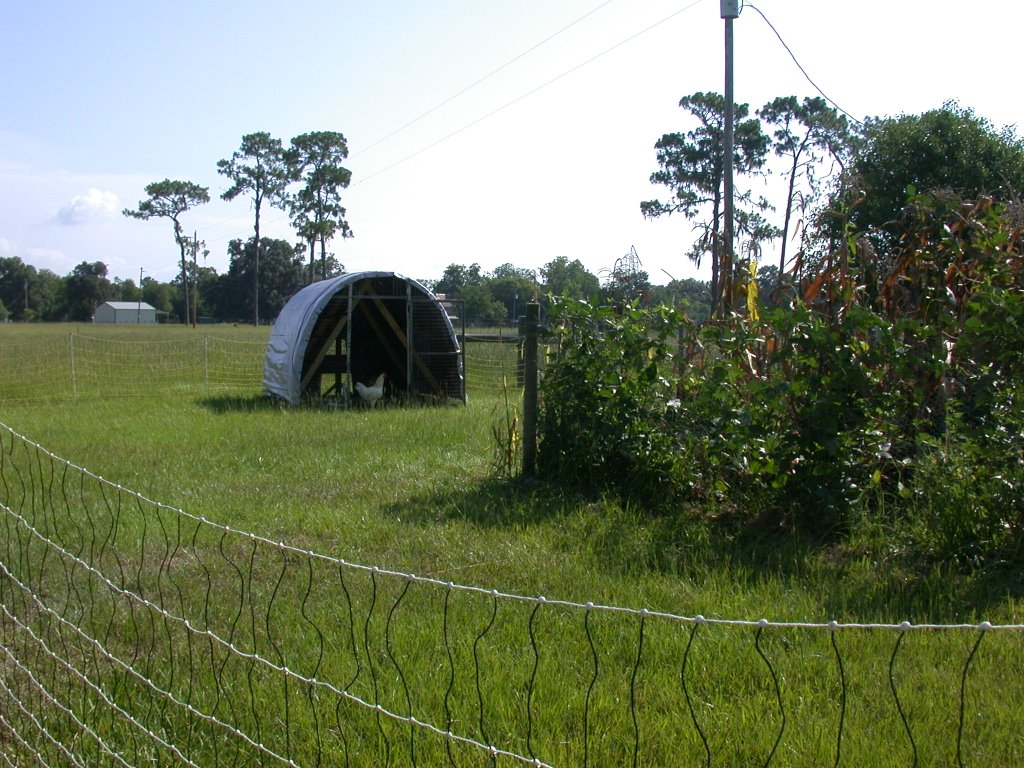 The reason for the floor is to make it easy to move the chickens from place to place. The floor is 1 x 2 inch cage wire over 2 x 4 inch floor joists. It is not necessary to clean it out because the poop just falls through the wire floor to the ground.
To move the chickens I just go out after dark and shut the door. The next morning I can just tow the whole thing behind my pickup to a new location.
We did this Sunday morning shifting them to the garden spot near the house. The garden is done for now until the temperatures cool down a bit in the fall. I picked all the corn and most of the cowpeas but left the corn stalks and pea plants intact. This gives the chickens some shade and interesting places to scratch around in.
Friday, July 14, 2006
Processing Poultry
Last weekend I processed the first batch of broiler chickens we have raised this year.
The good news is that all the paying customers got the chickens they wanted and seemed very happy about it. The bad news is that there was none left for me.
We need more chickens and soon to fix that.
I made a little video of the process, it runs a little over 12 minutes. If you have any sort of broadband connection and don’t mind the realities of converting live birds into food then you may want to have a look. It is in windows media format.
The good news is that all the paying customers got the chickens they wanted and seemed very happy about it. The bad news is that there was none left for me.
We need more chickens and soon to fix that.
I made a little video of the process, it runs a little over 12 minutes. If you have any sort of broadband connection and don’t mind the realities of converting live birds into food then you may want to have a look. It is in windows media format.
Wednesday, July 05, 2006
Fourth of July weekend
You may have noticed that posting is getting more and more sparse as summer comes on. That is not because nothing is going on, it’s because so much is going on I just haven’t been taking the time to write about it.
Dave, my best pal from our old address, came up with his family for part of the Fourth of July weekend.
 It was especially good to see his oldest son Alex, who was on a short leave after finishing his second year at West Point.
Cadets don’t get summers off. It just amazes me that some one so young can have so much on the ball.
----
The big news as to farming is the new gadget we just got. A Chinese mousetrap for sheep that allows us to trim hoofs without getting beat up.
We wormed all the lambs and wet ewes and trimmed all the hoofs on those ewes on the Fourth.
 We try not to herd sheep around here on the theory that it is better to lead than to follow.
Here is my bride AKA “The Corn Goddess” leading the beasties to their pedicure session.
Click on the picture to enlarge it.
----
Around the house and around the farm we use tools and equipment all the time to accomplish what we want to do.
I’ve noticed that at any given time some of these contraptions are broken.
At the moment my riding lawn mower and my weed whacker are both in the shop. That’s bad enough, but what’s worse is that the most critical piece of equipment on the place is out of commission.
That’s right, my easy chair is busted! Bummer!
Dave, my best pal from our old address, came up with his family for part of the Fourth of July weekend.
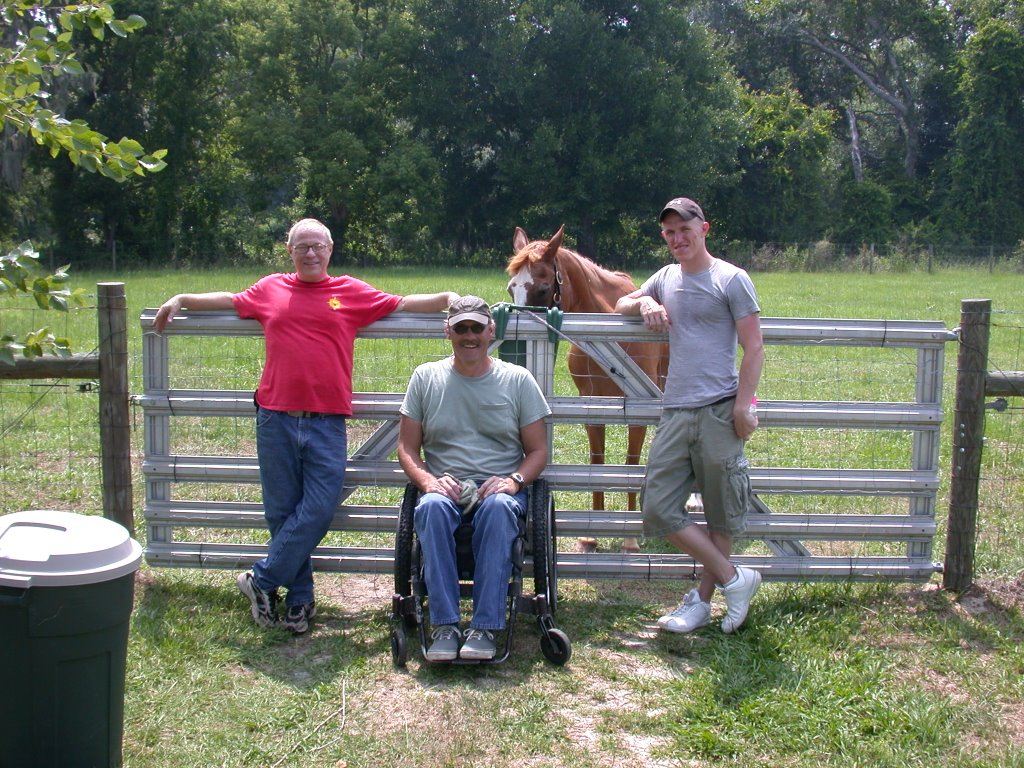 It was especially good to see his oldest son Alex, who was on a short leave after finishing his second year at West Point.
 Cadets don’t get summers off. It just amazes me that some one so young can have so much on the ball.
----
The big news as to farming is the new gadget we just got. A Chinese mousetrap for sheep that allows us to trim hoofs without getting beat up.
We wormed all the lambs and wet ewes and trimmed all the hoofs on those ewes on the Fourth.
 We try not to herd sheep around here on the theory that it is better to lead than to follow.
 Here is my bride AKA “The Corn Goddess” leading the beasties to their pedicure session.
Click on the picture to enlarge it.
----
Around the house and around the farm we use tools and equipment all the time to accomplish what we want to do.
I’ve noticed that at any given time some of these contraptions are broken.
At the moment my riding lawn mower and my weed whacker are both in the shop. That’s bad enough, but what’s worse is that the most critical piece of equipment on the place is out of commission.
That’s right, my easy chair is busted! Bummer!
Subscribe to:
Posts (Atom)

