Quite a few years ago now I came across a title in a bin full of marked down hardback books at a chain bookstore outlet near where I lived. I had never heard of the author but the subject matter had to do with farming so I picked it up.
It told the story of a young California farmer trying to continue and grow a family farm that had already been in place for several generations.
That plot line by itself would be enough to interest me, but the author, aside from being a farm kid was an academic, specifically an authority on classical civilizations (Greece, Rome, etc) in the California University system.
The book contained some interesting information about the ancient Greek Yeoman farmer and comparisons to the modern family farmer that has become more and more stressed these past few decades.
Anything that portrays individualism in a positive light is sure to get my approval. I very much enjoyed the book.
I have a good friend who I lent the book to after it came up in conversation. He took it home and read it. His wife pointed out that the author had been published lately in the National Review magazine. The author is, for those who haven’t figured it out already, Victor Davis Hanson. The book was “Fields without Dreams”.
He still writes prolifically, here: http://victordavishanson.pajamasmedia.com/ and other places. Most of what I see out there is political. I often agree with him, I often disagree. I always admire his well-reasoned logic.
I think he sees himself as a farmer more than an author or an academic. I think he would give the title of farmer a loftier status than the others. I have not seen him say that in so many words, but that’s how I read him.
He did a blog entry the other day that touched one the subject of “Mad Farmers” that gave me a chuckle.
Thursday, March 29, 2007


Tuesday, March 27, 2007
Was it really Raining?
I'm fairly sure it rained around here once, long ago.
In the last post I said we got nearly half and inch. Guess how much we have had since then. That dry dusty cough was the answer.
I just looked at the ten day forecast. A 10% chance of rain was the biggest number in the whole forecast.
I read on the other farm blogs that everyone is struggling through mud season. If you are in that situation, please feel free to send some of that moisture down here.
Friday, March 16, 2007
It's Raining!
Rain and just in the nick of time. We have had about one half inch of rain since last night.
If I listen close I swear I can hear the grass grow.
I have a load of supplemental feed coming today for the ewes to get them through lambing and lactation.
But there should be no need to supply forage, and a good thing to, since one thing I have in common with everyone else around here is that I am out of hay.
Tuesday, March 13, 2007
How to buy a bull
Anyone who has attempted to raise livestock for any length of time is all too aware that even though we do all we can as far as animal husbandry goes, some times the beastie just insists on dying.
Sometimes this is caused by some mistake, but that is a different matter. We can and do expend great amounts of effort to create an environment where our stock can be healthy and productive. Past that, their survival is just not up to us as farmers.
A friend’s bad time with kidding got me thinking about this. This person keeps goats primarly for livestock shows.
I was at a place last weekend where folks were discussing livestock for show, like the 4H kids do. I know nothing about show stock. I’ve never done it, never been around it.
The notion of looking at a group of animals and by that contact alone passing judgment on which is best always struck me as odd.
Show stock seems to have the same relationship to production stock that theology has to religion; that is, none that's obvious. *
Judging stock by its looks seems odd to me because my dad used to tell a story about how to buy a bull. To be honest I though this was a long dull story when I was growing up. He told the story many times.
It went like this; there was this farmer who had a reputation all over the area for being able to find and buy the best bulls. He had done this for many years and as far as anyone could remember he never got a bad one.
He was present at a sale where several bulls were on offer and was asked by a group of prospective buyers how they could tell which was best. They asked about size, top line, muscling, color, and stance, any and all the physical attributes of a bull.
They asked the old farmer all sorts of questions about bulls but they couldn’t seem to keep him on topic. He had all sorts of unrelated questions he wanted answered.
Who is the seller? Have you been to his place? Is it extravagant and showy or simple and functional? Have you met his family? Have you gone to the town where he does business and asked about him?
What do the production records tell you about the animal? Does he through good calves? Has he been bred to heifers and if so how did they do?
My dad would go on and on about the things that needed answering before even looking at the bull, no doubt that’s why I though the story was so dull.
At every point, with each new fact learned, if the result was negative, the old farmer’s advice was to give up on the bull and look for a different one. No need to even look at the beast unless all the background checked out well.
The punch line of the story was that when the prospective buyer finally did look at the bull, the advice was "If you like it you buy it".
The fact that I listened to this story many times growing up does not make me an expert on show stock of course.
I can’t help but suspect that what was selected for in breeding these animals has not been the sorts of pro-survival traits that are used for production stock.
* I came up with this line, something shamelessly stolen from R. Heinlein on a different subject, when I was composing this post in the shower the other day. When I wrote it down I forgot the line. I do shower regularly, so I remembered it this morning.
Monday, March 12, 2007
Maintenance Mode
We have been in sort of a maintenance mode for the past several months here at the A3 farm.
The cattle have been next door with my neighbor’s herd all winter. Each day we feed horse, dogs, cats and sheep.
We collect eggs. We feed the laying hens when they need it. Since Mid January we’ve had broiler chickens to feed water and move each day.
Some of the equipment has been serviced and some fencing work done. Mostly farm work has been as minimal as farm work ever gets.
I’ve done two business trips related to my day job. One trip was to Arizona, which was pretty, and one to the DC suburbs, which was not. OK, Montgomery County Maryland is fine for those who like that sort of thing, but traffic and snow are two things I would be happy to do without.
Things here on the farm are about to change from maintenance mode to the more usual state of affairs, which is “way too much to do and not enough time to do it”.
The laying hens have been moved away from their winter quarters, that spot is ready to disk.
I started processing the broilers yesterday and will finish, I hope, next weekend.
 It’s time to get more feed into the ewes, lambing is just a month off.
The grass will start to grow if we ever get rain.
All the hay we put up last summer is gone.
I bought two rolls of peanut hay, not perennial peanut, regular peanut. We have one lonesome roll of it left.
If we get rain any time soon it will be enough. If we don’t get rain I think I’ll take the ewes down to the welfare office and sign them up for food stamps :-).
One great thing about farm living is that the seasons have meaning beyond switching the thermostat from heat to AC and back. Even down here where we have fewer seasons than some places.
 Just to get everyone in the mood for lambing, a new calf was born Saturday across the fence on the neighbor’s place.
Thursday, February 01, 2007
January Broilers
 I got a new batch of broiler peeps a little over two weeks ago. These are Cornish Cross meat type chickens.
I have a small battery brooder that is about the right size for a batch of 25 chicks. That’s where these birds have been since I got them.
This is the first time I’ve started a batch in mid winter. At other times of the year I leave them in the brooder no more than two weeks. They grow so fast they get too big for it.
I left them in the brooder almost three weeks this time because we had a cold snap and I thought it might be too much for them to be in the pasture pen. It was just an overnight frost, only the second this year.
I put them on the pasture yesterday. Overnight lows were in the forties. They seem fine today.
I think the bigger they get the better they will handle cold. I know that in the summer the heat is a real problem for older birds.
I have customers that want chicken. I’m out myself.
Tuesday, January 30, 2007
Pepper
 This 11-week-old English Shepard pup moved in with us on Sunday. The goal is to train him into a general-purpose farm dog that can herd sheep when necessary.
The name “Pepper” was chosen after we got him home and was not even suggested before that. I told my bride quite sometime before we got him that I thought I’d call him “Bubba”.
She said that it was going to be my dog and I could give him any name I wanted to, but that I didn’t want to name him Bubba. Then she gave me that look that means, “Drop it or I’ll have to hurt you”. So much for the name Bubba.
I considered trying to come up with a name that played off of how the dog looked. I also considered coming up with a name that had something to do with his job as a farm dog.
He is a black dog with a little white, like salt and pepper. But Pepper is the name of the Ben Johnson character in the John Wayne movie “Chisum”. The Pepper character is the trail boss/ranch foreman.
Way back in the mid 70’s my dad and his business partner ran about 3000 sheep open range style on a bunch of leased coal company land in Southern Ohio. This was done with horses, several 19 and 20 year old kids, and one very well trained Border Collie.
I was one of the 19 year old kids, and that dog was better than wonderful in that situation but it needed full time work or it would go crazy. In my opinion Border Collies are just like that, they can’t be really happy with out a full time job.
We met some women that raise English Shepard’s at one of the Meat Sheep Alliance meetings a few years ago. That breed seemed like the a calmed down Boarder Collie, able to cope with herding and other farm chores but also able to cope with snoozing on my office floor while I play computer geek.
We made a deal with the breeders some time ago for a pup, and this is it; Pepper.
Sunday, January 21, 2007
Zap the beasties - for their own good
 I've been trying to learn rotational grazing since we started fooling with sheep a few years back.
The farm is divided into three different pastures with permanent fence. The leased land would count as one more pasture I guess.
I subdivided the big home pasture, 10 acres give or take, into four paddocks with temporary electric fences.
I subdivided the leased land into four paddocks originally using the same sort of fencing. I have since dropped that down to two paddocks. This is because there are only two water sources over there and sharing them between paddocks was not working too well.
What I have is a bunch of small pastures rather than a proper rotational grazing system.
I still have a very low stocking rate. Something like half of what this land should carry. I want to grow my way larger instead of buying my way larger.
In the late fall I was having trouble with the sheep moving through the electric fences.
I tried several things to fix this including changing from plastic twine to 14 gage aluminum.
I went to three strands from two on the rented land. I got a better energizer.
I had a notion that the sandy soil and the dry weather had something to do with it but I had no idea what to do about it.
So a few weeks ago I was reading though book "Greener Pastures on Your Side of the Fence" by Bill Murphy. He teaches a much more intense form of rotational grazing than I have been using. No suprise he uses electric fences.
At one point he states that in dry sandy soils as many as ten grounding rods may be needed. He recommends grounding to a metal culvert under a roadway or an unused well casing.
My energizer was connected to one grounding rod. I moved the unit back to the well house for our old (no longer in use) well. I has a two inch galvanized well casing about 80 feet deep.
All the paddock fences are hot now even though most of the gates are open. So far they seem to be staying well clear of them although I haven't seen any of them get shocked.
So far so good.
Wednesday, January 17, 2007
Winter is for projects
The warm season grasses are dormant. The cool season grasses are slowly starting to grow but are not yet ready for grazing. There is no hay to make. Lambing is still months away. Breeding is done.
Sounds like there’s not much to do on the farm, right? Wrong!
The tractor needs it’s fluids changed. The chicken pens need repair. Several gates are dragging the ground and hard to use. The generator won’t start. The barn lot fence needs fixing. Last springs ram lambs are market age. All the ewes need a pedicure.
Most of these things have been done this winter and the others are in progress.
This far south a January day could be 80 degrees (yesterday) or it could be in the thirties (today). I’ve got a fresh batch of broiler chickens in the brooder. I hope they don’t turn into just so many little peep-sickles.
All the market lambs are sold but five. I’m tempted to have them butchered before I sell them. They are cheaper to keep in the freezer that in the pasture, but it is best to sell them live if I can.
This year all lambs have been sold directly to the consumer, nothing went to the sale barn.
I’m trying to work out a way to sell meat by the cut rather than by the head but I don’t think I’ll have that worked out before this lot is gone.
All together this is plenty enough to fill these short winter days.
Monday, December 18, 2006
Big honking chicken tractor
 Last year I did an experiment where I grew some OP corn and some cowpeas.
This year I plan to scale the whole thing up quite a bit.
Last week we move our laying hens to the spot where the row crop patch will be.
Into this space we dumped most of the hay that got rained on last summer.
 The idea is that between a six inch deep layer of mulch hay and thirty some chickens scratching around and fertilizing the place, the ground will be plowed and far better for growing things in than the beach sand that we have in place of topsoil in this part of the country.
I plan to plant corn in rows thirty inches apart with cowpeas between each row.
Both these photos show the same spot of ground.
I’m hoping that with the mulch and the chickens I can get away with just sticking the seeds into the ground. I don’t own a plow and don’t really want to.
I’m hoping for two crops, one about the forth of July, one in the late fall.
I’ll harvest the summer crop by turning newly weaned lambs into it, a little at a time. They can eat everything down to the ground. This should keep them from loosing condition at weaning time, and even put some weight on them.
The fall crop should help finish them.
Tuesday, December 05, 2006
Like lambs to the slaughter
 This is not “like” lambs to slaughter, it IS lambs to the slaughter.
Five ram lambs whet to the butcher shop the Tuesday after thanksgiving.
These five were sold to six different customers. Two people split the largest one.
We picked up three of them today, including the big one with two owners.
One of these is in our freezer here at the farm so that the lady that bought it can pick it up at her leisure. She has an intense job that made it impossible for her to get it during the week.
We still have eight market lambs left. Any that have not been sold before the Dec 16 livestock sale go to auction then.
Monday, November 20, 2006
Winter Annuals
Conspiring with one of my neighbors last weekend we planted some winter annuals on parts of both our places.
We planted by simply broadcasting seed on pastures that had been deliberately over grazed this fall. Then we used a drag to try and cause better seed soil contact. We planted equal parts oats, rye grass and wheat.
They tell me that we should have done this a bit earlier according to the University studies. Considering we have had no rain since I was a good bit younger (or so it seems) I don’t see how it could matter.
Now we just have to wait and see what happens. If we do get rain I expect the resulting growth will help a lot in the early spring. Otherwise we just spread so much birdseed.
You pay your money and you take your chances, that’s farming.
This is the first time I’ve tried to do this, but it’s something that was commonly done in the area when farms were more self-sufficient than they are now.
It was also very common to make hay on a small scale the way I am doing it. These days most of the cattle farms just buy hay. This year there was a drought year and there is no hay to buy.
There will be a lot of brood cows going to market before spring.
We have hay, enough to get us through even if the winter annuals don’t perform well, barley. This is not because I’m smarter than most, but just because I like old hay equipment and doing things the way the old folks did them.
It’s better to be lucky than good.
Saturday, November 18, 2006
A Different Christmas Poem
I usually limit this blog to farming related topics, but that's my rule, so I get to break it. Enjoy.
A Different Christmas Poem
The embers glowed softly, and in their dim light,
I gazed round the room and I cherished the sight.
My wife was asleep, her head on my chest,
My daughter beside me, angelic in rest.
Outside the snow fell, a blanket of white,
Transforming the yard to a winter delight.
The sparkling lights in the tree I believe,
Completed the magic that was Christmas Eve.
My eyelids were heavy, my breathing was deep,
Secure and surrounded by love I would sleep.
In perfect contentment, or so it would seem,
So I slumbered, perhaps I started to dream.
The sound wasn't loud, and it wasn't too near,
But I opened my eyes when it tickled my ear.
Perhaps just a cough, I didn't quite know,
Then the sure sound of footsteps outside in the snow.
My soul gave a tremble, I struggled to hear,
And I crept to the door just to see who was near.
Standing out in the cold and the dark of the night,
A lone figure stood, his face weary and tight.
A soldier, I puzzled, some twenty years old,
Perhaps a Marine, huddled here in the cold.
Alone in the dark, he looked up and smiled,
Standing watch over me, and my wife and my child.
"What are you doing?" I asked without fear,
"Come in this moment, it's freezing out here!
Put down your pack, brush the snow from your sleeve,
You should be at home on a cold Christmas Eve!"
For barely a moment I saw his eyes shift,
Away from the cold and the snow blown in drifts..
To the window that danced with a warm fire's light
Then he sighed and he said "Its really all right,
I'm out here by choice. I'm here every night."
"It's my duty to stand at the front of the line,
That separates you from the darkest of times.
No one had to ask or beg or implore me,
I'm proud to stand here like my fathers before me.
My Gramps died at 'Pearl on a day in December,"
Then he sighed, "That's a Christmas 'Gram always remembers."
My dad stood his watch in the jungles of 'Nam',
And now it is my turn and so, here I am.
I've not seen my own son in more than a while,
But my wife sends me pictures, he's sure got her smile.
Then he bent and he carefully pulled from his bag,
The red, white, and blue... an American flag.
I can live through the cold and the being alone,
Away from my family, my house and my home.
I can stand at my post through the rain and the sleet,
I can sleep in a foxhole with little to eat.
I can carry the weight of killing another,
Or lay down my life with my sister and brother..
Who stand at the front against any and all,
To ensure for all time that this flag will not fall."
"So go back inside," he said, "harbor no fright,
Your family is waiting and I'll be all right."
"But isn't there something I can do, at the least,
"Give you money," I asked, "or prepare you a feast?
It seems all too little for all that you've done,
For being away from your wife and your son."
Then his eye welled a tear that held no regret,
"Just tell us you love us, and never forget.
To fight for our rights back at home while we're gone,
To stand your own watch, no matter how long.
For when we come home, either standing or dead,
To know you remember we fought and we bled.
Is payment enough, and with that we will trust,
That we mattered to you as you mattered to us."
LCDR Jeff Giles, SC, USN
30th Naval Construction Regiment
OIC, Logistics Cell One
Al Taqqadum, Iraq
Thursday, November 16, 2006
Farmers Market
 After two weeks I judge the new farmers market to be a success.
No one is getting rich there, especially me, but it allows me to sell all my eggs and get some good face time in with potential customers for other things.
I need to get some pictures or the actual market.
It runs each Friday from 4 to 7 PM. Midmorning I go up and park the trailer as a sort of announcement. This is the trailer set up in my barn. I thought a hayride look would be good.
Monday, November 13, 2006
My public demands it!
My last blog post was quite some time ago indeed. Today I got this comment:
There have been lots of things happening on and around the farm with the obvious exception of blog postings.
We have established something of a new routine here with the sheep herd. At the MSA meeting (see previous post) we learned a lot about internal parasites and how to manage them.
The ofending vermin is Haemonchus contortus, commonly known as the barberpole worm.
This visious little beasty is a major problem here with our hot wet climate. We have lost several sheep to this bug.
One fact about how it works struck me. It lays on the ground and is rather inert until the grass becoms wet. It then “swims” up the grass blade where it can be eaten by a sheep.
If the grass is dry it is very unlikely that the sheep will ingest the parasite.
 Our sheep tend to graze heavly right at daybreak, no doubt because it is cooler than later in the day. Dew is usually very heavy here. If you walk a pasture early in the day it will soak through your clothes.
Sheep in the dry lot
The new routine is this, in the evening the sheep get penned up in the dry lot not to be release til the dew burns off the next day, typically about 10:00 AM.
We are now at the beginning o f breeding season. The ewes are divided into two groups, each with one of the rams. The market lambs are in yet another group.
The ewes and the rams have been on opposite sides of a fence for a week or so. They have been making kissy noises back and forth all that time.
Judging by the activity so far, lambing season should be short and early next spring.
Three of the 14 market lambs have been sold to 4 different people, the ultimate consumers.
I'm still working out the logistics of getting animals to the butcher and meat to the customers but we will get it done somehow.
I just came back from a visit to the butcher shop I'll be working with. It is a very nice little operation. Clean and professionally run. I was impressed.
Cheryl said...How about that? I’ve been missed. Time to get back into gear.
Now, you can't just leave your 2 blog fans in suspenders like this. How about an update? ;)
Cheryl
WA state
There have been lots of things happening on and around the farm with the obvious exception of blog postings.
We have established something of a new routine here with the sheep herd. At the MSA meeting (see previous post) we learned a lot about internal parasites and how to manage them.
The ofending vermin is Haemonchus contortus, commonly known as the barberpole worm.
This visious little beasty is a major problem here with our hot wet climate. We have lost several sheep to this bug.
One fact about how it works struck me. It lays on the ground and is rather inert until the grass becoms wet. It then “swims” up the grass blade where it can be eaten by a sheep.
If the grass is dry it is very unlikely that the sheep will ingest the parasite.
 Our sheep tend to graze heavly right at daybreak, no doubt because it is cooler than later in the day. Dew is usually very heavy here. If you walk a pasture early in the day it will soak through your clothes.
Sheep in the dry lot
The new routine is this, in the evening the sheep get penned up in the dry lot not to be release til the dew burns off the next day, typically about 10:00 AM.
We are now at the beginning o f breeding season. The ewes are divided into two groups, each with one of the rams. The market lambs are in yet another group.
The ewes and the rams have been on opposite sides of a fence for a week or so. They have been making kissy noises back and forth all that time.
Judging by the activity so far, lambing season should be short and early next spring.
Three of the 14 market lambs have been sold to 4 different people, the ultimate consumers.
I'm still working out the logistics of getting animals to the butcher and meat to the customers but we will get it done somehow.
I just came back from a visit to the butcher shop I'll be working with. It is a very nice little operation. Clean and professionally run. I was impressed.
Tuesday, October 24, 2006
Fall 2006 Florida MSA Conference
MSA is an acronym for Meat Sheep Alliance.
The fall conference was a two-day affair last Friday and Saturday, October 20 and 21.
Actually Thursday was an optional trip to the Sunbelt Ag Expo in Moultrie Georgia so it could be said that the conference was three days long. We didn’t take the trip so can’t comment on that part of the event.
Other than the field trip, the conference was held at Lake City Community College.
I was surprised to see that part of the setup included quite a number of live animals, specifically sheep and sheep dogs.
 Lake City has no Ag school and no ready-made facilities for containing livestock. Pens were set up in and around a large truck garage.
Several talks and classes were given by a lineup of imported heavy hitters in the realm of sheep husbandry. Several Veterinarians with advanced specialties, as well as PhD’s in Breeding and Genetics.
When I listen to land grant University types talking about farm policy I either get angry or go to sleep. These guys were not that type.
These folks are over educated farm kids with a passion for livestock and dirt (among other things) under their fingernails. Coming from me, this is a complement.
We took a class in FAMACHA, which is an approach to parasite control that minimizes the use of anthelmintics (chemical wormers).
 We saw a herding dog demonstration.
The dogs were show dogs primarily.
Trailer, Sheep, Dog .. No fences .. don't try this at home.
Farm dogs do some (fewer) of the same things, but they do them all day long (if needed) and in all sorts of conditions.
I need one of these (farm type) dogs.
 Different breeds of sheep common in this area were present.
Florida Native a.k.a. Gulf Coast Native sheep
Monday, October 23, 2006
Eggs and other farm stuff
A lot has been going on here at the A3 farm, with the obvious exception of keeping the blog entries up to date.
My bride and I both took last week off from our non-farm jobs and mostly spent the time on farm related tasks (big surprise).
We did a few things to get ready from the opening of the farmers market on November third.
We are selling eggs at the market. We plan to use my brides lap top computer to show photos and maybe videos of our production system.
I made a video that proves 1) Steven Spielberg is safe in his job, and 2) I’m a sucker for corny old Bob Wills tunes, even those done by Asleep at the Wheel.
It is in Windows Media Format.
Link to video
We also spent two days at the fall meeting of the Florida Meat Sheep Alliance, held this time at Lake City Community College. I’ll do a separate post about this. I got some good pictures.
Thursday, October 05, 2006
Bovine boogie
 I don’t own a bull. I own two cows and a calf.
My next-door neighbor keeps 10 cows and a bull. His bull is a nice one that he named turbo. Every bit of two thousand pounds of vary large farm animal.
We often help each other out, I check his stock when he leaves town for example.
Last year he let me run my cows in with his to get them bred. We did this at midsummer when he had more grass than he could use.
This year rain has been scarce, except when I am trying to make hay of course. His pasture is not holding up too well.
My ground is still under stocked and I have some grass to spare. So this year we are running our cattle together on some of my ground. We turned them all in on Monday.
Just now I came by and saw my two cows and his bull lounging under the big shade tree.
Is it just my optimistic nature, or do they look like they have all just finished having a cigarette?
Home made peeps
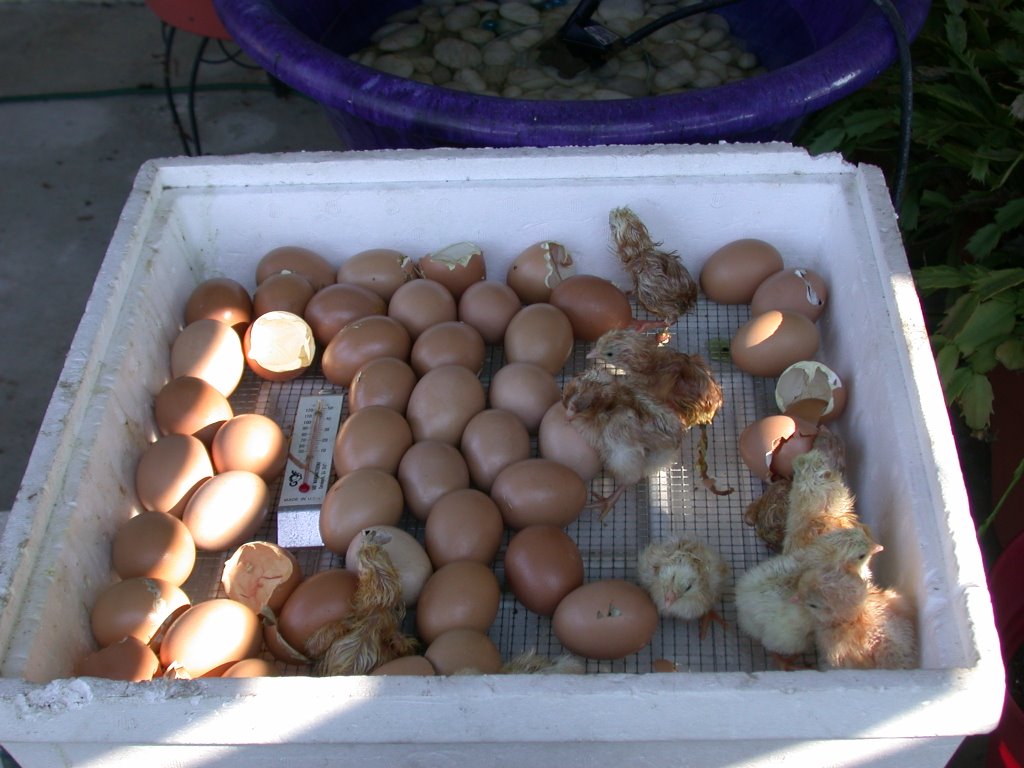 A while ago I figured out that in order to sell eggs at the new farmers market I would need to offer them as fertilized hatching eggs rather than table eggs.
This is, for the most part, a dodge to avoid AG department busybodies who seem to believe that eggs come from factories and therefore prohibit anyone who doesn’t have a factory from selling eggs. They don’t know about chickens apparently.
Well, I may be forced to play wink and nod, but I wanted to know if such a claim would be true. So I borrowed a small incubator from a friend and installed four-dozen eggs in it.
I keep two roosters with my laying hens, so the eggs should indeed be fertile. Up to now I have never hatched any.
Well, I more or less forgot about them. Every few days I’d roll them around in the incubator. I lost track of when I put them in there.
Yesterday they started to hatch. I knew they were supposed to hatch of course, but I was still surprised.
 I was at the feed store yesterday buying feed for the laying hens. It never entered my mind to get chick starter.
I went out just now and got starter feed, then put the ones that have hatched into the brooder.
Ten have hatched so far.
Wednesday, October 04, 2006
Aerial Photography courtesy of google earth
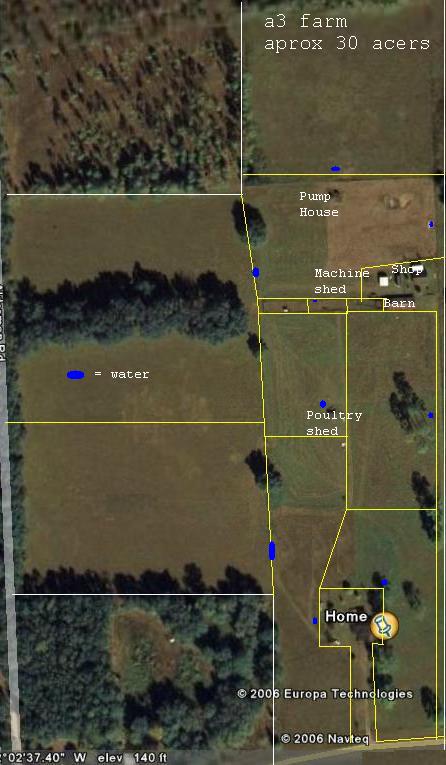 If you have never played with google earth then you still have a good bit to learn about wasting time.
Having said that, if you are lucky enough to live in a place where the satellites take a close look it is possible to get some good aerial photos of home (or just about anywhere else).
I pulled this photo of our farm and did an edit of it. Cool, huh?
I added indications of where the rotational grazing paddocks are, where water is available, and where the various buildings are.
The upper and lower left is adjoining land that we don’t use. The center left is land that belongs to my neighbor that we graze. It is subdivided into two paddocks at the moment. The large rectangle at the right is our land.
Subscribe to:
Posts (Atom)

